28
Apr 10

Teignmouth Harbour

More pictures from Teignmouth, 23 March 2010.

Looking from New Quay across to the Fish Quay, with Shaldon Bridge and the sheds of Teignmouth Docks visible  in the background.

New Quay from Back Beach. The quay was constructed in 1820 by George Templer to facilitate the shipping of Dartmoor granite from Haytor.  The building under scaffolding to the right of the picture is now the New Quay Inn, but in the days when fishing and fish trading were the mainstays of the town it was known as The Newfoundland Fishery. The house in Northumberland Place, where Keats and his brother stayed in 1818 is reached via a narrow street just off to the right – only a stone’s throw from the river.

In amongst the modern additions of tarmac, street lighting, road signs etc., which initially seem to have obliterated the history of the quays, there is still plenty of evidence of past activity.

New Quay – sheds and storage out on the river’s edge.


23
Apr 10

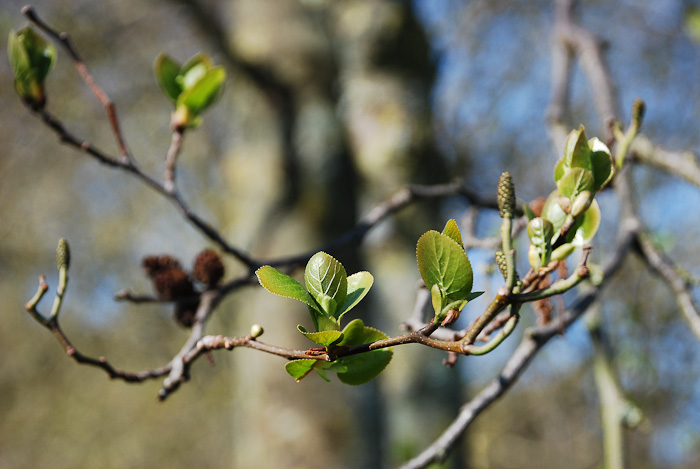
Alder leaves


20
Apr 10

Ghosts

Anybody searching Teignmouth for the ghost of John Keats is following a well-trodden path. Charles Causley wrote a poem inspired by his visit in the 1950s:

Keats at Teignmouth

Spring, 1818
By the wild sea-wall I wandered
Blinded by the salting sun,
While the sulky Channel thundered
Like an old Trafalgar gun.

And I watched the gaudy river
Under trees of lemon-green,
Coiling like a scarlet bugle
Through the valley of the Teign.

When spring fired her fusilladoes
Salt-spray, sea-spray on the sill,
When the budding scarf of April
Ravelled on the Devon hill,

Then I saw the crystal poet
Leaning on the old sea-rail;
In his breast lay death, the lover,
In his head the nightingale.

© Charles Causley, Collected Poems 1951 – 2000

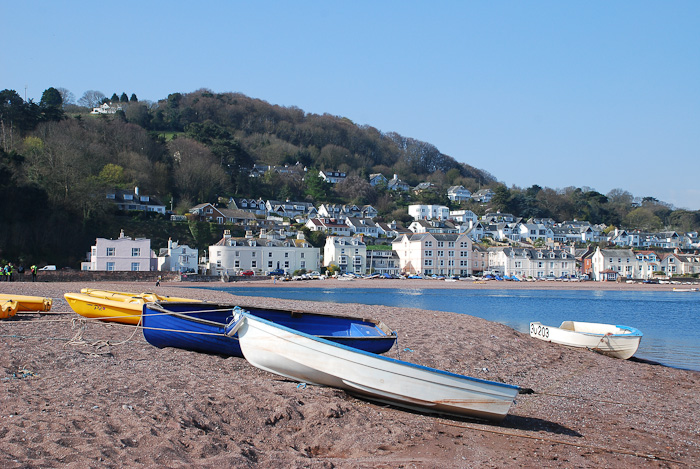
Shaldon village and surrounding hillsides (above) photographed from Back Beach, Teignmouth, 20 April 2010. Due to the late spring this year there wasn’t much evidence of new foliage to be seen, but the weather was a good deal better than Causley (and Keats) experienced – the line ‘coiling like a scarlet bugle’ conjures up a vivid image of the river laden with soil after days of rain.


13
Apr 10

Robert Louis Stevenson

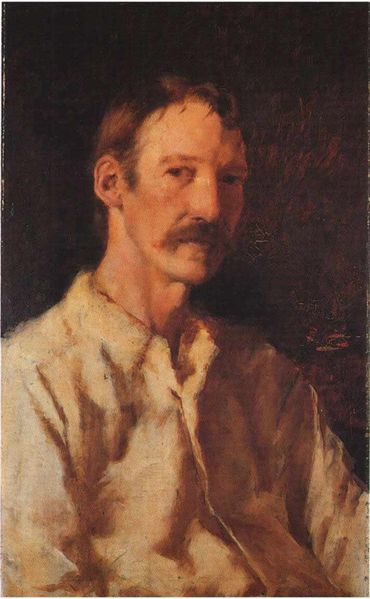
Robert Louis Stevenson (1850 – 1894). Portrait by Girolamo Nerli, 1892.

*  *  *  *  *

I’ve recently finished reading Claire Harman’s thoughtful and affectionate biography of Robert Louis Stevenson. He seems to have been an unusually likeable person as writers go, though perhaps best appreciated at a distance. As a child I found Treasure Island too frightening to finish and the biography is good at conveying a kind of cheerful ruthlessness in Stevenson’s character. My favourite behind-the-scenes glimpse of this was his own description of his nicotine habit in a letter to J M Barrie in 1893, the year before he died: “Cigarettes without intermission except when coughing or kissing.”


William Ernest Henley (1849 – 1903)

*  *  *  *  *

According to Robert Louis Stevenson’s letters, the idea for the character of Long John Silver was inspired by his real-life friend   W. E. Henley. Stevenson’s stepson, Lloyd Osbourne, described Henley as “… a great, glowing, massive-shouldered fellow with a big red beard and a crutch; jovial, astoundingly clever, and with a laugh that rolled like music; he had an unimaginable fire and vitality; he swept one off one’s feet”. In a letter to Henley after the publication of Treasure Island Stevenson wrote: “I will now make a confession. It was the sight of your maimed strength and masterfulness that begot Long John Silver… the idea of the maimed man, ruling and dreaded by the sound, was entirely taken from you”.

As well as being the author of the much-quoted Invictus (‘I am the master of my fate: I am the captain of my soul.’) Henley also wrote the rather piratical poem,  Madam Life’s a Piece in Bloom:


Madam Life’s a piece in bloom,

Death goes dogging everywhere:

She’s the tenant of the room,

He’s the ruffian on the stair.


You shall see her as a friend,

You shall bilk him once or twice;

But he’ll trap you in the end,

And he’ll stick you for her price.


With his kneebones at your chest,

And his knuckles in your throat,

You would reason — plead — protest!

Clutching at her petticoat;


But she’s heard it all before,

Well she knows you’ve had your fun,

Gingerly she gains the door,

And your little job is done.

*  *  *  *  *

There’s also a good audio version on YouTube


11
Apr 10

Blackthorn

Blackthorn bushes growing beside the River Exe near Powderham.


11
Apr 10

River Exe near Turf Lock

The Turf Lock Hotel was built in 1827 at the mouth of the Exeter Ship Canal to provide accommodation for the lock keeper and the crews of vessels using the canal.

Looking south towards the mouth of the river.


09
Apr 10

Hazel

- The Hedges by this time are beginning to leaf -

John Keats: Letter to B. R. Haydon – 8 April 1818


07
Apr 10

Back Beach


01
Apr 10

Back Beach

Teignmouth has a long tradition of shipbuilding, from at least the 17th century. By the turn of the 19th century there were three shipyards in Teignmouth itself, and three in Shaldon and Ringmore on the other side of the estuary. The industry declined in the early 20th century, but in 1921 Francis Charles Morgan-Giles bought the last derelict shipbuilding yard and gave the industry a new stimulus. His shipyard became a major employer in the town, building pleasure craft in peacetime and small craft such as torpedo boats during World War II. However, the business eventually failed in 1968. The tall residential building visible on the right of the photo above was constructed on the site of the old shipyard and is called Morgan’s Quay. Since it was completed in 1990 public access has been restored to this section of Back Beach.

Riverside bird feeders.

There are a number of these posts along the beach – according to Viv Wilson’s book, Teignmouth Then and Now, they were used for mooring sailing ships under repair. This particular one has been adapted to multiple uses.